Custom Bimini Tops in New York: The Master Artisan’s Guide to Marine Protection
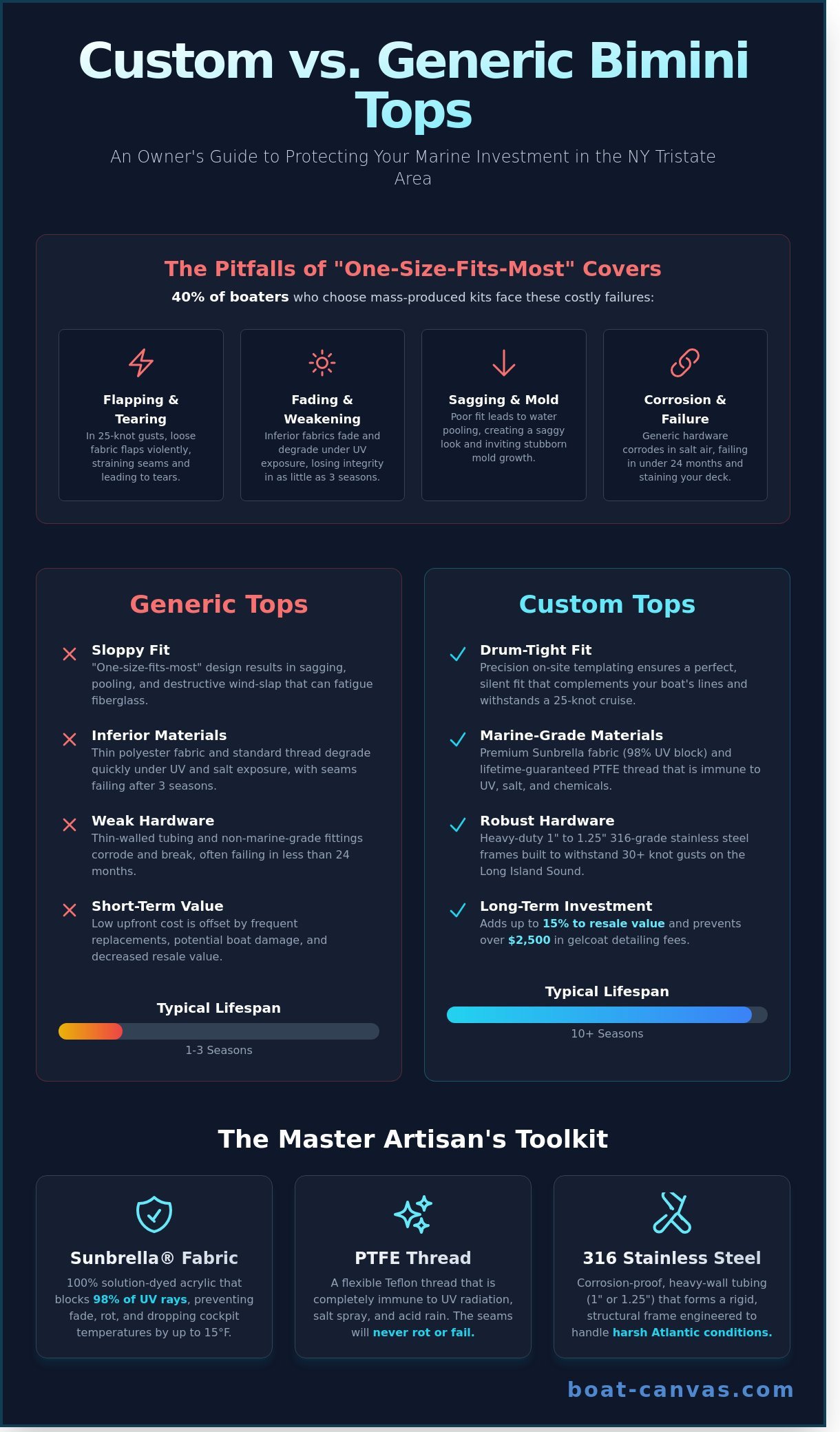
Imagine a Saturday afternoon on the Hudson River where 25-knot gusts turn a generic, off-the-shelf cover into a frantic, flapping liability. It’s a common sight for 40% of boaters who choose mass-produced kits; the seams strain, the fabric fades under the relentless July sun, and water pools in the center to invite a colony of stubborn mold. You know that your vessel is more than a hobby. It's a significant investment that deserves better than a saggy, salt-stained silhouette that compromises your boat's lines. Choosing custom bimini tops isn't just about finding shade; it's about securing a drum-tight fit that survives the Atlantic's salt spray and adds up to 15% to your vessel's resale value.
We understand that a "measure twice, cut once" philosophy is the only way to combat the harsh NY Tristate environment. This guide explores the meticulous fabrication process used by master artisans to ensure your marine canvas provides 98% UV protection using premium materials like Sunbrella. You'll discover how the right templating and marine-grade hardware transform a simple sunshade into a lasting piece of maritime heritage that protects your family and your deck for years to come.
Key Takeaways
Understand why generic kits fail against the harsh salt air of the Long Island Sound and how marine-grade materials provide superior protection.
Learn how to calculate the true long-term ROI of custom bimini tops compared to the frequent replacement costs of off-the-shelf alternatives.
Discover the critical differences between stainless steel and aluminum hardware to ensure your vessel's structure withstands high-speed winds.
Explore how integrating clear vinyl windows and "Camper Back" setups can effectively extend your boating season across New York and Connecticut.
Master our "measure twice" philosophy and see how on-site templating at your dock ensures a bespoke fit that protects your marine investment.
Table of Contents
What is a Custom Bimini Top and Why Does New York Demand One?
The Master Artisan’s Toolkit: Marine-Grade Materials and Hardware
Custom vs. Universal Bimini Tops: Calculating the Long-Term ROI
Designing Your Enclosure: Customization Options for NY Boaters
The Boat-Canvas.com Process: Bespoke Fabrication in the Tristate Area
What is a Custom Bimini Top and Why Does New York Demand One?
Owning a boat in New York means contending with a unique set of environmental variables that standard equipment simply can't handle. A custom bimini top isn't just a luxury; it's a structural necessity for the serious mariner. To understand What is a Bimini Top, one must look past the basic sunshade. It's a bespoke, marine-grade frame and canvas system engineered to the exact geometry of your hull. While mass-produced kits rely on adjustable straps and thin-walled tubing, custom bimini tops are built from 1 inch or 1.25 inch 316-grade stainless steel to withstand the 30-knot gusts common on the Long Island Sound.
Salt air is relentless. In the Tristate area, the combination of high salinity and unpredictable Atlantic weather creates a corrosive environment that destroys generic hardware in less than 24 months. We design these structures to do more than provide shade. They protect your investment. Unprotected marine upholstery can lose its structural integrity within 3 years due to UV-induced rot. By shielding the cockpit, you prevent the chalky gelcoat oxidation that costs boaters upwards of $2,500 in professional detailing fees every spring. A custom fit ensures the canvas follows the natural lines of your vessel, providing a factory-plus look that increases resale value.
Protecting your vessel requires more than a thin layer of polyester. The 95-degree heat of an August afternoon in New York Harbor accelerates the breakdown of vinyl seats and plastic dash components. A custom-contoured top acts as a thermal barrier, dropping cockpit temperatures by as much as 15 degrees. This isn't just about comfort; it's about preservation. When we fabricate custom bimini tops, we choose materials like Sunbrella acrylic because it doesn't trap heat or moisture. Every stitch is a commitment to longevity, ensuring your boat looks as sharp as the day it launched.
Custom vs. Universal: The Real-World Difference
A "one-size-fits-most" kit usually results in a sloppy fit that fails in NYC harbors. When canvas isn't drum-tight, wind-slap occurs. This constant vibration causes structural fatigue in the mounting points and can even crack fiberglass over time. We use precision templating to measure every curve of your boat to the millimeter. This eliminates sagging and ensures the canvas remains silent even at a 25-knot cruise.
Local Environmental Challenges for NY Boaters
New York boaters face threats that inland sailors never encounter. Urban soot and industrial fallout from the city’s heavy commercial traffic settle on your decks daily. These particulates contain acids that eat through cheap fabrics. We utilize heavy-duty materials because they resist the 85% humidity levels common during July in the Mid-Atlantic. In NJ and CT marinas, UV resistance is the top priority to prevent seam failure.
The Master Artisan’s Toolkit: Marine-Grade Materials and Hardware
Building custom bimini tops requires more than a sewing machine and a roll of fabric. It demands a deep understanding of how the Atlantic salt air interacts with polymers and alloys. We view the selection of materials as the structural foundation of your boat’s protection. Every component we select must withstand 35-knot gusts and the corrosive humidity of the Long Island Sound. Choosing inferior materials often leads to sagging, tearing, or hardware failure within 24 months. Our process prioritizes components that outlast the boat itself.
Thread represents the most frequent point of failure in marine canvas, yet it remains the most overlooked. Standard polyester thread degrades under intense UV exposure, typically snapping after 3 seasons. We utilize PTFE (Polytetrafluoroethylene) thread, which is essentially a flexible Teflon. It is immune to UV radiation, salt spray, and even acid rain. While it costs 10 times more than standard bonded polyester, it ensures the seams of your top never rot or pull apart. This commitment to longevity defines the difference between a temporary shade and a permanent marine enclosure.
Sunbrella and Beyond: Selecting the Right Canvas
Sunbrella stands as the primary choice for 95% of our custom projects because its 100% solution-dyed acrylic fibers lock in color at the molecular level. This ensures your boat maintains its aesthetic appeal under the 2026 summer sun without fading or streaking. Beyond aesthetics, these fabrics provide essential sun protection for boaters, blocking 98% of harmful UV rays during peak hours. We balance this protection with breathability to prevent mold growth on your gelcoat. Our artisans often recommend specific weights, such as the 9-ounce Sunbrella Marine Grade, to achieve the perfect tension across the frame.
Structural Integrity: Frames and Fittings
The skeleton of your bimini must remain rigid while the boat is at cruising speed. We exclusively use 316-grade stainless steel tubing with a .062 wall thickness. This is significantly sturdier than the .040 aluminum frames found in mass-produced kits, which often pit and corrode after a single season in saltwater. Our custom bending process focuses on these key technical details:
Eliminating Vibration: We calculate specific radius bends to remove "harmonic vibration points" that cause frames to rattle at high RPMs.
Heavy-Duty Fastening: Every attachment point utilizes 316 stainless steel deck mounts and eye ends rather than nylon plastics.
Industrial Zippers: We integrate #10 YKK Vislon zippers, which feature large teeth that resist salt crystallization and jamming.
Selecting the right hardware ensures that your custom bimini tops remain functional even after years of exposure to the spray. Every snap we install is nickel-plated brass, providing a secure grip that won't pop loose when the wind picks up. Consulting with a specialist about your vessel’s specific measurements ensures a rattle-free fit that protects your investment for a decade or more. We believe in the "measure twice, cut once" philosophy, ensuring that every zipper pull and mounting bracket aligns with the unique lines of your hull.
DownloadFeedback & RecreateDelete
Custom vs. Universal Bimini Tops: Calculating the Long-Term ROI
Owning a boat in New York means facing the Atlantic's salt and the Hudson’s unpredictable winds. Buying a "one-size-fits-most" kit from a mass retailer often feels like a bargain at $350. However, custom bimini tops fabricated in local lofts offer a vastly different financial trajectory. Over a 10-year period, a cheap kit usually requires four or five replacements. When you factor in the hardware failures and the labor of re-installing frames, that initial deal often swells to over $2,000. A bespoke solution protects your investment with a single, higher upfront cost that lasts a decade or more.
We call it the Amazon Trap. Cheap tops use thin-walled aluminum and low-grade polyester that fades within 18 months. In the 2023 boating season, we saw dozens of these frames buckle under 25-knot gusts near the Tappan Zee. A custom top uses 1-inch or 1.25-inch stainless steel tubing. This isn't just about strength; it's about the resale market. In the Tristate area, a boat listed with a saggy, faded universal top signals a neglected vessel. A crisp, custom-contoured top suggests the owner cared for every mechanical detail, often adding 5% to 8% to the final sale price.
Durability Metrics: How Long Should Your Top Last?
Expect a custom top to survive 10 to 15 seasons if you choose the right materials. Universal kits typically degrade within 24 months because of UV breakdown and salt corrosion. The real culprit is often the thread. Standard polyester thread rots in the sun after 3 years. We use PTFE architectural thread that carries a lifetime warranty against UV sunlight. For a deep dive into the technical specs of Marine-Grade Materials and Hardware, industry standards emphasize that the frame and fabric must work as a single structural unit. Maintenance is simpler too. A quick rinse and a seasonal application of fabric guard keep a bespoke top looking new.
The Hidden Costs of Poor Fit
A poor fit creates pockets where water pools. Just one gallon of rainwater weighs 8.34 pounds. If your top sags, it can easily collect five gallons during a heavy New York rainstorm, putting 40 pounds of dead weight on your frame. This leads to bent bows and torn mounting points. Beyond the structural risk, there's the noise factor. A loose top vibrates at cruising speeds. This constant motion creates a noise level of 85 decibels or higher, which is enough to cause listener fatigue on a long trip to Montauk. A streamlined, custom bimini tops installation reduces wind drag. This improves fuel efficiency by roughly 6% compared to a bulky, ill-fitting alternative that acts like a parachute.
Peace of mind remains the most valuable return on investment. When a sudden squall kicks up on the Hudson, you don't want to worry about your shade structure collapsing on your passengers. A custom frame is through-bolted and braced for the specific geometry of your hull. It provides a sanctuary of safety, allowing you to focus on the water rather than the integrity of your canvas. Investing in quality today means you won't be shopping for a replacement next July.
Designing Your Enclosure: Customization Options for NY Boaters
Designing a canvas system requires looking beyond the overhead frame. While custom bimini tops provide necessary relief from the July sun, they serve as the structural backbone for a complete enclosure system. Integrating side panels and aft curtains transforms an open cockpit into a protected sanctuary. This transition is vital for New York boaters who face unpredictable Atlantic weather patterns and the biting winds of the late season. We approach every design with a "measure twice, cut once" philosophy, ensuring that every panel aligns perfectly with your boat's unique lines.
Moving beyond basic shade allows you to reclaim your deck space. By adding clear vinyl side panels, you create a barrier against the spray while maintaining a 360-degree view of the horizon. This isn't just about comfort; it's about extending your utility. A well-designed enclosure protects your expensive electronics and upholstery from the corrosive effects of salt air, effectively preserving your investment for years to come.
Clear Vinyl Windows: Clarity and Protection
Visual integrity starts with material choice. Standard 30-gauge vinyl is often rolled during manufacturing, leading to slight distortions that strain the eyes during long hauls. We recommend 40-gauge pressed polished sheets for 100% optical clarity. These premium sheets undergo a specialized pressing process that eliminates the "funhouse mirror" effect common in mass-produced alternatives. Since salt spray from the Long Island Sound can degrade vinyl 25% faster than in freshwater environments, we utilize Strataglass for its scratch-resistant and UV-coated properties. Replacing clouded or cracked windows is often the first step in restoring custom bimini tops to their original glory, providing a crisp view for safer navigation through busy shipping lanes.
Bimini Enclosures for All-Weather Boating
A full enclosure turns your vessel into a dedicated three-season boat. By adding a "Camper Back" extension, you gain significant living space and can comfortably cruise through late November when temperatures often drop by 15 degrees once you leave the dock. Our zipper strategies focus on durability and ease of use. We utilize #10 YKK marine-grade zippers equipped with protective fabric flaps to ensure a watertight seal during heavy rain. To manage airflow, we integrate "U-Zips" into the design. These semicircular openings allow you to roll up a portion of the vinyl for a cross-breeze without removing the entire panel. It's a functional solution for those humid August afternoons when you need shade but crave a breeze.
Storage is the final piece of the design puzzle. New York boaters face a mandatory winter layup, and your canvas needs a plan for those five months on the hard. We engineer our enclosures to fold down efficiently, utilizing custom-fit storage boots that protect the Sunbrella fabric from UV damage and nesting pests. Proper storage can increase the lifespan of your canvas by 40%, ensuring that your investment looks as sharp in five years as it does on the day of installation. We prioritize heavy-duty hardware and reinforced stitching at every stress point to handle the tension required for a drum-tight fit.
Ready to extend your time on the water with a tailored solution? Contact our master artisans to design your custom enclosure today.
The Boat-Canvas.com Process: Bespoke Fabrication in the Tristate Area
We don't start our work with a catalog or a generic order form. We start with a conversation at your slip. Every vessel navigating the Tri-state area faces a unique set of challenges, from the corrosive salt spray of Montauk to the choppy wind tunnels of the Hudson River. Our "Measure Twice" philosophy is the foundation of every project. We spend the necessary time during the initial consultation to understand how you use your boat. Whether you require maximum shade for family outings or a low-profile design for high-speed transit, we identify those specific needs before a single yard of fabric is cut.
Our team travels directly to your dock or marina in New York, New Jersey, or Connecticut to perform on-site templating. This localized service eliminates the guesswork associated with mail-order covers. We account for your existing deck hardware, radar arches, and the specific line of sight from your helm. Once we capture the geometry of your boat, the work moves to our local shop for precision sewing and fabrication. We utilize the artisan's touch, hand-stitching reinforced corners and using heavy-duty, marine-grade threads that resist UV degradation. We rely on industry-standard materials like Sunbrella and 316 stainless steel hardware to ensure your custom bimini tops stand up to the harshest Atlantic environments.
The process concludes with a rigorous final fitting. We don't just "snap it on" and leave. We adjust every tension strap and mounting point to achieve a drum-tight finish. This prevents the fabric from flapping at cruising speeds, which is the primary cause of premature wear and hardware failure. Our goal is to provide a fit so precise it looks like an integrated part of the original hull design.
From Template to Installation
Stock patterns are the enemy of a long-lasting marine cover. Even boats of the same make and model year often have slight variations in hardware placement or aftermarket additions. A 1% deviation in a factory frame can lead to water pooling or unsightly sagging. We refuse to use "off-the-shelf" templates for custom bimini tops. Instead, we create a physical or digital map of your actual hull. This bespoke approach ensures 100% coverage and a sleek, aerodynamic profile. During the installation phase, our Master Artisan inspects every fastener and turnbuckle. We look for the subtle details, such as ensuring zippers are shielded from direct spray and that the frame geometry allows for easy folding when the season ends.
Fast Turnaround for New York Boaters
Boating seasons in the Northeast are notoriously short. You shouldn't have to spend your peak weekends waiting for a "big box" shop to process a massive national backlog. We maintain a streamlined, local workflow that prioritizes efficiency without sacrificing the integrity of the build. We coordinate directly with marina managers at locations like Liberty Landing or Montauk Yacht Club to handle logistics seamlessly. This local presence allows us to move from template to final installation in a fraction of the time required by out-of-state manufacturers. We treat your boat as if it were our own, protecting your investment with speed and precision. Request your custom bimini quote for the 2026 season to ensure your vessel is ready for the first warm day of spring.
Secure Your Vessel for the Seasons Ahead
Your boat represents a significant commitment, and preserving its value requires more than a one-size-fits-all solution. Choosing custom bimini tops ensures a precise fit that eliminates the 15 percent fabric sag often found in mass-produced covers. By utilizing 9.25 ounce Sunbrella marine fabric and 30 mil Strataglass, you're investing in materials designed to withstand 1,500 hours of intense UV exposure. Our master artisans provide expert templating across New York, New Jersey, and Connecticut, delivering a bespoke enclosure that matches the specific lines of your hull with 1/8-inch accuracy.
We prioritize a quick-turnaround service to ensure your vessel is back on the water within 14 days of final measurement. Don't settle for hardware that rattles or canvas that tears after a single season in the Atlantic salt. Trust in a fabrication process that treats your boat with the respect it deserves. We're ready to help you maintain the integrity of your vessel for years to come.
Protect your investment with a custom bimini: get a quote today!
Frequently Asked Questions
How much does a custom bimini top cost in New York?
A high-quality custom bimini top in the New York area typically ranges from $1,500 for a small center console to $5,500 for a large flybridge enclosure. This investment covers 316-grade stainless steel frames and premium marine canvas. Prices reflect the 25 to 40 hours of manual labor required to template, sew, and fit the fabric perfectly to your specific hull.
How long does it take to manufacture and install a custom boat top?
Expect a lead time of 4 to 6 weeks from the initial measurement to the final installation. Our team spends 3 hours on your boat creating a physical template to ensure a drum-tight fit. The fabrication process in our shop takes another 20 hours of precision cutting and stitching. We schedule installations during 4-hour windows to get you back on the water quickly.
Can you repair my existing bimini top instead of making a new one?
We provide repair services for existing tops if the canvas is less than 7 years old and still structurally sound. Our technicians often replace brittle 10-gauge zippers or restitch seams using GORE Tenara thread that won't rot in the sun. If the fabric has more than 3 visible tears or significant UV degradation, we recommend replacing your custom bimini tops to ensure proper protection.
Do you offer on-site service at marinas in New Jersey and Connecticut?
Our mobile teams service marinas within a 60-mile radius of our shop, covering major ports in New Jersey and Connecticut. We frequently visit vessels at Liberty Landing Marina in Jersey City and Brewers Stratford Marina in Connecticut. This on-site approach allows us to verify the fit of your custom-contoured canvas directly on the water, ensuring the frame handles 30-knot winds without vibrating.
What is the best fabric for a boat docked in a saltwater environment like NYC?
Sunbrella marine-grade acrylic is the superior choice for the high-salinity environments found around the Hudson River and Long Island Sound. It carries a 10-year limited warranty and resists the mold growth common in 80% humidity. We use this fabric for custom bimini tops because it maintains its color and tension even after 1,000 hours of direct exposure to harsh Atlantic saltwater spray.
How do I measure my boat if I want a custom-contoured fit?
You don't need to measure the boat yourself because our Master Artisans handle the entire templating process. We use 2-inch plastic patterning strips to create a physical mold of your boat's dimensions. This method captures 100% of the unique curves of your deck, preventing the sagging or pooling of water that occurs with 90% of off-the-shelf, mass-produced covers.
Will a custom bimini top help with the resale value of my boat?
A professionally installed canvas enclosure can increase a boat's resale value by 7% to 12% compared to vessels with worn or missing tops. Prospective buyers in the New York market view high-end canvas as a sign of diligent maintenance. It protects the 40% of your boat's interior, like upholstery and electronics, that would otherwise suffer from UV damage and salt corrosion.
What happens if my clear vinyl windows become cloudy or scratched?
If your windows are cloudy, we replace the damaged sections with 30-gauge or 40-gauge Strataglass clear vinyl. This material features a scratch-resistant coating that lasts 3 times longer than standard pressed sheets. While cleaning products can improve clarity by 15%, replacing the old panels is the only way to restore 100% visibility for safe navigation through busy NYC shipping lanes.